



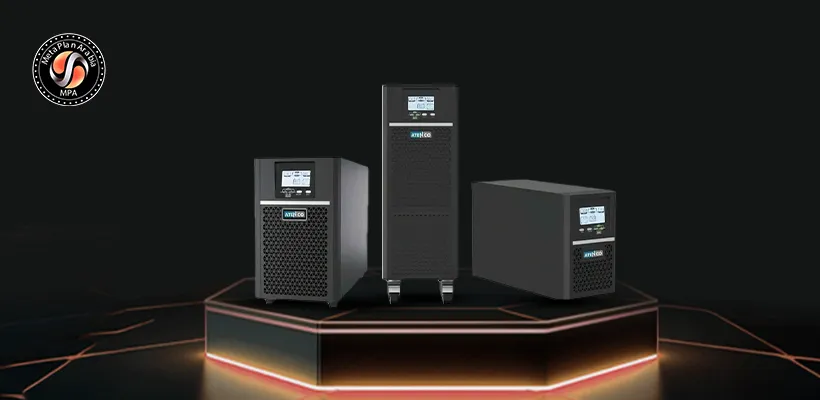
Choosing a 10-40 kVA Three-Phase UPS starts with measured load, required runtime, electrical architecture, and expansion needs, because capacity alone cannot define a safe solution.
MetaPlan supplies TM33E systems for Saudi facilities that need reliable online protection across data centers, industrial controls, telecom rooms, healthcare infrastructure, and demanding commercial buildings.
online UPS protection for three-phase critical loads
An online UPS continuously converts incoming AC power to DC and then recreates regulated AC output, so sensitive equipment remains supplied through the inverter during normal operation.
This double-conversion architecture provides zero transfer time between utility and battery operation, while the internal static bypass supports configured fault or overload conditions without replacing correct system design.
A 10-40 kVA Three-Phase UPS is therefore appropriate when three-phase loads require conditioned 380, 400, or 415 Vac output, predictable power quality, and coordinated battery backup.
The three phase UPS range includes TM33E tower models that combine three-phase input and output, online double conversion, and project-configured battery arrangements for critical facilities.
Share the protected load, site voltage, runtime target, and redundancy requirement with MetaPlan to identify the right capacity before equipment, batteries, and accessories are ordered.
industrial UPS capacity comparison from 10 to 40 kVA
An industrial UPS should be selected by usable kilowatts as well as apparent power, because two products carrying the same kVA label may support different real-power loads.
The TM33E UPS models listed by MetaPlan use an output power factor of 1.0, meaning the 10, 20, 30, and 40 kVA ratings correspond to matching kilowatt ratings.
| Capacity | Usable output at PF 1.0 | Typical decision context | Battery arrangement |
|---|---|---|---|
| 10 kVA | 10 kW | Smaller server rooms, telecom, controls | Internal-space or external-battery model |
| 20 kVA | 20 kW | Growing IT or industrial control loads | Internal-space or external-battery model |
| 30 kVA | 30 kW | Manufacturing, enterprise, larger IT loads | Internal-space or external-battery model |
| 40 kVA | 40 kW | High-load enterprise and critical infrastructure | External or configured internal-space model |
A 10-40 kVA Three-Phase UPS should normally retain engineered headroom for temporary peaks, future growth, and operating resilience instead of running continuously at its absolute published limit.
10 kVA three phase UPS for smaller centralized systems
A 10 kVA three phase UPS suits measured critical loads below 10 kW when the installation also matches its phase configuration, voltage, peak demand, and runtime plan.
The product range lists TM3310L and TM3310SE configurations, while its 10 kva 3 phase ups guidance explains load, battery, tower, and installation decisions in substantially greater detail.
20 kVA UPS for growing facilities
A 20 kVA UPS provides up to 20 kW on the verified PF 1.0 TM33E platform, making it suitable where a 10 kVA system lacks sufficient headroom.
30 kVA UPS for higher continuous demand
A 30 kVA UPS fits larger server, communications, automation, and commercial loads when their combined measured demand, inrush behavior, environmental conditions, and maintenance plan are fully documented.
40 kVA UPS for mission-critical infrastructure
A 40 kVA UPS delivers up to 40 kW on the verified unity-power-factor configuration, but actual suitability still depends on distribution, selectivity, bypass design, cooling, and load characteristics.
The 10-40 kVA Three-Phase UPS range can also support matching parallel units for capacity expansion or N+X redundancy when approved accessories, firmware, cabling, protection, and commissioning requirements are satisfied.
UPS battery cabinet and runtime planning
A UPS battery cabinet extends stored energy, but runtime must be calculated from the real load, battery quantity, capacity, DC voltage, age, temperature, charger capability, and discharge limits.
MetaPlan lists the TC060180N cabinet with internal space for as many as eighty 12 V 9 Ah batteries, an integrated breaker, battery cables, wheels, and shipment without batteries.
This cabinet description does not guarantee a particular runtime, because the usable arrangement must match the selected 10-40 kVA Three-Phase UPS and the manufacturer-approved DC bus configuration.
Projects requiring only generator-start bridging may need less stored energy than facilities requiring controlled shutdown, extended processing, or prolonged continuity for communications and industrial control systems.
Request a detailed load-based battery calculation to define the cabinet, battery count, autonomy, charging recovery, protection, and installation space requirements as one coordinated project design.
TM33E UPS technical features to verify
The TM33E UPS is a transformerless 3:3 tower platform using IGBT rectifier and inverter stages, DSP control, pure sine-wave output, and online double-conversion VFI operation.
Published manufacturer data identifies PF 1.0 output, input power factor of at least 0.99, and input current distortion of no more than three percent under stated linear-load conditions.
The 10–30 kVA models support a wider derated input window than the 40 kVA model, so engineers must verify full-load voltage limits instead of relying on the broadest advertised range.
Monitoring choices include local displays and project-dependent RS-232, USB, RS-485 Modbus, dry contacts, EPO functions, relay cards, and optional SNMP communication for remote supervision.
The manufacturer states that as many as four matching TM33E units can operate in parallel, subject to compatible ratings, approved parallel accessories, matching firmware, protection coordination, and qualified commissioning.
According to the official TM33E technical information, generator use also requires appropriate generator sizing, voltage regulation, frequency stability, load-step response, and charging-current settings.
ups installation requirements in Saudi facilities
A compliant 10-40 kVA Three-Phase UPS installation begins with site verification covering voltage, phase arrangement, neutral and earthing, breakers, cable sizing, bypass, ventilation, access, and environmental exposure.
The general online UPS planning guidance explains how protected-load priorities and runtime objectives should be established before individual products and batteries are finally selected.
High ambient temperature can shorten battery life and increase cooling demand, so the UPS room and battery area need controlled temperature, adequate airflow, dust management, and maintenance clearance.
A 10-40 kVA Three-Phase UPS must also be coordinated with generator capacity, because the generator supplies the protected load, conversion losses, battery charger demand, and any simultaneous facility loads.
How to specify a three-phase UPS system
A useful specification starts with an equipment schedule showing maximum watts, power factor, starting current, load criticality, permitted interruption, expected growth, and required operating time during an outage.
Next, engineers confirm whether the protected load genuinely requires three-phase output, because a three-phase building supply can still feed equipment that needs single-phase UPS distribution.
The selected 10-40 kVA Three-Phase UPS must satisfy both kVA and kW limits while retaining appropriate margin, rather than being selected from nominal capacity or equipment count alone.
Battery design follows the agreed autonomy at the calculated load, while redundancy, maintenance bypass, remote monitoring, generator compatibility, and future expansion remain separate decisions within the complete system architecture.
three-phase UPS quotation factors
A comparable quotation must cover more than the UPS rating, because batteries, autonomy, cabinet, bypass, communications, delivery, installation, commissioning, warranty, and service coverage define the complete project scope.
For a 30 kVA system, suppliers should identify whether batteries are internal or external, state the calculated runtime, and list every protection, communication, installation, and commissioning component separately.
For a 40 kVA system, buyers should compare usable output, battery inclusion, cabinet capacity, bypass architecture, redundancy, environmental requirements, warranty, and technical-service coverage before evaluating competing quotations.
MetaPlan quotations should therefore be requested against a documented load schedule and identical technical scope, preventing incomplete equipment-only proposals from being compared with commissioned backup-power solutions.
A 35 kVA rating is absent from the verified TM33E sequence, so buyers should obtain an engineered comparison between standard 30 and 40 kVA models instead of assuming an intermediate configuration.
10-40 kVA Three-Phase UPS sizing with MetaPlan
MetaPlan can evaluate the measured load, phase arrangement, runtime, battery architecture, generator, monitoring, bypass, and redundancy requirements before recommending a specific TM33E configuration and project scope.
Send MetaPlan the load schedule, maximum demand, site voltage, required autonomy, room conditions, generator details, monitoring preference, and expansion plan to receive a technically comparable proposal.
Frequently Asked Questions about 10-40 kVA Three-Phase UPS
These concise answers explain the quotation process without publishing figures, because a reliable comparison still requires matching capacity, battery runtime, accessories, installation, commissioning, warranty, and service scope.
A 40-kVA quotation depends on the selected topology, battery runtime, cabinet, bypass, monitoring, redundancy, installation, commissioning, warranty, and service scope, so each project requires individual evaluation.
A 30 kVA quotation depends on whether batteries are internal or external, the required autonomy, communication accessories, bypass design, delivery, installation, testing, commissioning, warranty, and maintenance coverage.
There is no standard TM33E 35 kVA model in the verified sequence, so buyers should compare engineered 30 and 40 kVA proposals rather than estimate an unsupported intermediate figure.
A 3-phase UPS requires a project quotation based on capacity, usable kilowatts, batteries, autonomy, cabinet, bypass, monitoring, installation, commissioning, warranty, and service rather than a standalone catalogue figure.