



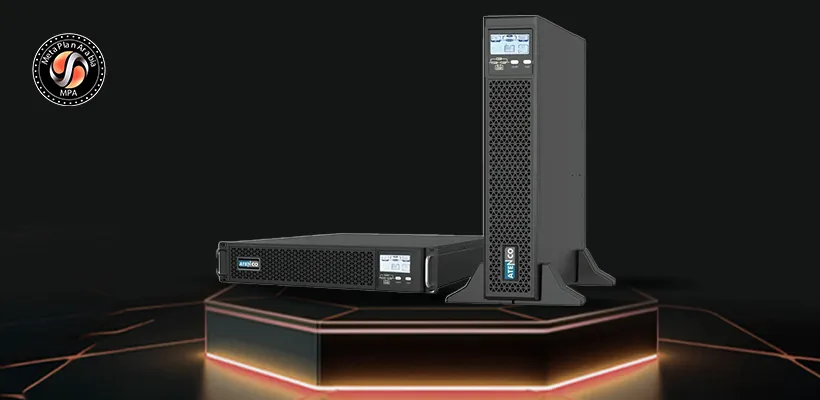
A 6-10 kVA UPS protects medium-sized critical loads, but the correct rating depends on usable kilowatts, load growth, required runtime, phase arrangement, and battery configuration.
MetaPlan helps Saudi organizations compare these variables before selecting equipment for servers, networks, security systems, laboratories, industrial controls, and other loads requiring dependable continuity during utility disturbances.
6-10 kVA UPS sizing starts with usable power
The nameplate rating describes apparent power, while the supported real load depends on output power factor, so a 6-10 kVA UPS must be checked in both kVA and kW before purchase.
For example, a 6 kVA unit rated at 0.9 power factor can supply up to 5.4 kW, while a unity-power-factor design can theoretically supply 6 kW.
The same calculation means a 10 kVA model rated at 0.9 power factor supports 9 kW, whereas a unity-power-factor model may support 10 kW under specified conditions.
Designers should total maximum equipment wattage, include startup or transient demand, then retain an operating margin for growth rather than running a 6-10 kVA UPS continuously at its absolute limit.
Each 6-10 kVA UPS proposal should also state whether its output rating remains available across the specified temperature, voltage, battery, bypass, and operating conditions for the intended site.
MetaPlan can review the connected-load schedule and desired autonomy before quotation, helping the buyer avoid undersizing, unnecessary capacity, or a battery arrangement that cannot meet the operating objective.
6 kVA vs 10 kVA UPS: the practical decision
The 6 kVA vs 10 kVA UPS decision should follow measured load, supported watts, expansion plans, and runtime objectives, because a larger 6-10 kVA UPS label does not automatically produce longer backup time.
| Decision point | 6 kVA option | 10 kVA option |
|---|---|---|
| Typical usable output | About 4.8–6 kW, model dependent | About 8–10 kW, model dependent |
| Best fit | Smaller server, network, CCTV, or control loads | Larger combined loads or greater expansion allowance |
| Battery requirement | Internal or external, depending on model | Often larger internal strings or external cabinets |
| Installation impact | Lower weight and space requirement | Higher cable, protection, cooling, and space requirements |
A 6 kVA UPS suits a calculated load that remains safely within the unit’s kW rating after margin, while its battery system supplies the required outage response.
A 10 kVA UPS becomes appropriate when the supported equipment, peak demand, or planned growth clearly exceeds the practical operating envelope of the smaller system.
Choosing ten kilovolt-amperes solely for longer autonomy is unreliable, because UPS runtime depends mainly on battery energy, load percentage, inverter efficiency, temperature, battery condition, and manufacturer discharge data.
single phase UPS and online double-conversion protection
A single phase UPS in this range is commonly selected for server rooms, network racks, surveillance platforms, medical equipment, laboratories, and technical workstations supplied from compatible low-voltage infrastructure.
Online double conversion continuously rectifies incoming AC to DC and reconstructs regulated AC through the inverter, giving sensitive loads conditioned output without normal transfer delay when utility power fails.
This 6-10 kVA online UPS architecture can reduce exposure to voltage variation, frequency instability, and waveform disturbances, although every 6-10 kVA UPS still needs correct protection, earthing, ventilation, and coordination.
Buyers comparing ups 6 10 kva models should confirm input and output voltage, bypass arrangement, generator compatibility, harmonic limits, overload behavior, communication interfaces, and the exact supported kW.
Manufacturer literature for comparable online UPS products also distinguishes single-phase ratings, power factor, and rack or tower formats, reinforcing why catalogue capacity alone is insufficient.
high capacity UPS installation requirements
A high capacity UPS needs more than floor or rack space, because cable sizing, breakers, isolation, maintenance clearance, cooling, structural loading, and battery safety affect reliable commissioning.
Tower systems can simplify standalone placement, while rack models consolidate equipment inside technical cabinets; either format must preserve airflow, service access, rail compatibility, and safe weight distribution.
Saudi installations should also consider room temperature, dust control, utility characteristics, generator behavior, and accessible technical support, since harsh conditions can reduce battery life and change expected performance.
Monitoring through SNMP or dry contacts helps facilities teams receive alarms, record events, and coordinate shutdown procedures, but communication cards and licenses should be confirmed within the quotation.
Requesting a documented load assessment and installation scope from MetaPlan clarifies capacity, electrical requirements, accessories, site conditions, and commissioning responsibilities before equipment reaches the site.
external battery UPS design
An external battery UPS separates power electronics from scalable energy storage, allowing a 6-10 kVA UPS to meet defined autonomy requirements beyond the duration available from internal batteries alone.
UPS runtime calculation inputs
Correct UPS runtime calculations require the actual load in watts, DC bus voltage, battery quantity and capacity, discharge rate, inverter efficiency, temperature allowance, aging margin, and manufacturer runtime curves.
The UPS battery cabinet must match the selected model’s DC voltage, charger capability, battery chemistry, protection, cabling, ventilation, physical layout, and approved series arrangement.
MetaPlan’s Atenco range lists TM11E 6 kVA and 10 kVA long-run tower models for external batteries, while standard variants provide internal space for sixteen or twenty 9 Ah batteries respectively.
The same product range lists a tower cabinet with space for forty 12 V 9 Ah batteries and a rack cabinet with space for twenty, supporting different installation formats.
A larger cabinet does not guarantee a safe result unless charging current, recharge time, protective devices, cable voltage drop, battery matching, and maintenance access are engineered together.
UPS price factors for 6 kVA and 10 kVA systems
A single advertised 6-10 kVA UPS price can be misleading because brand, topology, supported kilowatts, phase arrangement, battery inclusion, autonomy, installation, warranty, monitoring, availability, and delivery change the final quotation.
Two systems carrying the same capacity label may have very different commercial scopes when one includes batteries, rails, cabinets, network cards, commissioning, delivery, or electrical installation while another includes only the UPS unit.
MetaPlan quotations should therefore be evaluated against the required technical scope and site conditions, without assuming that a product-only figure represents the complete installed and commissioned solution.
The phrase 10 kva ups price therefore needs a defined specification, while 6kva ups cost comparisons should state whether batteries, rails, cabinets, network cards, commissioning, and taxes are included.
For a defensible comparison, request quotations against one load schedule, one runtime target, one phase arrangement, and one accessory list instead of comparing incomplete headline prices.
The commercial comparison should also state warranty boundaries, preventive-maintenance options, battery replacement responsibilities, expected delivery, and exclusions, allowing procurement teams to compare equivalent outcomes without relying on unsupported headline figures.
A correctly scoped 6-10 kVA UPS quotation should separate equipment and energy-storage costs, because external cabinets, battery quantity, commissioning, monitoring, delivery, and electrical works can outweigh the base unit difference.
Quotation requirements for mid-range UPS systems
A complete 6-10 kVA UPS request should identify connected equipment, maximum watts, peak characteristics, required autonomy, input supply, output distribution, installation format, monitoring, environment, and expansion allowance.
- Provide equipment nameplates, measured demand, and any motor or transformer starting requirements.
- State whether the system must bridge a generator start, support controlled shutdown, or sustain operations longer.
- Confirm rack or tower placement, available dimensions, ventilation, access, and allowable structural loading.
- Ask for supported kW, power factor, efficiency, overload limits, bypass, warranty, and commissioning scope.
- Require an itemized battery configuration with predicted runtime at the stated load and aging assumptions.
This specification makes competing proposals comparable and prevents the selected 6-10 kVA UPS from being judged by capacity or purchase price while essential installation and battery costs remain hidden.
For the available 6-10 kVA UPS options, the quotation should identify the exact Atenco model, internal or external battery arrangement, compatible cabinet, accessories, and site-service scope.
MetaPlan assessment for medium-capacity UPS projects
MetaPlan can translate the load schedule and runtime target into a model-specific proposal covering usable output, battery architecture, tower or rack format, monitoring, installation planning, and commissioning requirements.
Send the equipment list, measured load, supply details, installation photos, and autonomy objective to receive a scoped comparison that separates the UPS, batteries, accessories, and site work.
Frequently asked questions about 6-10 kVA UPS
These answers summarize the capacity, runtime, and current Saudi price questions that buyers most often need resolved before requesting a model-specific technical and commercial quotation.
A 10 kVA UPS can support up to 10,000 VA, while usable watts depend on power factor; common designs provide 8–10 kW before applying an operating and growth margin.
A 6kVA UPS can carry 6,000 VA, but usable output may be about 4.8, 5.4, or 6 kW at power factors of 0.8, 0.9, or 1.0 respectively.
Runtime cannot be determined from 10 kVA alone; it depends on actual watts, battery energy, efficiency, temperature, battery age, and whether internal batteries or external cabinets are installed.
A 6kVA UPS cost depends on topology, usable output, batteries, runtime, format, monitoring, installation, and warranty, so an accurate amount requires a model-specific quotation based on the intended load.