



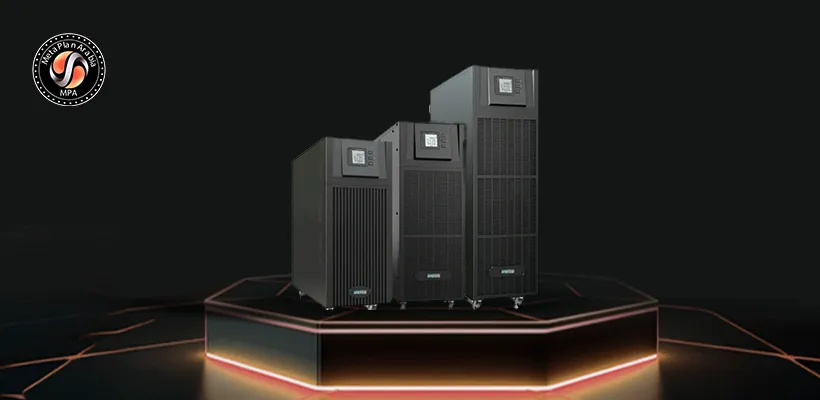
Single-Phase vs Three-Phase UPS selection should begin with the site supply, protected-load phase, measured kilowatts and kilovolt-amperes, required runtime, and expansion plan, because neither architecture is universally superior; MetaPlan can then match Saudi commercial or industrial facilities with a configuration that protects the actual electrical path without unnecessary capacity, distribution complexity, or installation cost.
Single-Phase vs Three-Phase UPS: the direct difference
A single-phase system uses one alternating-voltage waveform for its input or output, while a three-phase system uses three waveforms separated by 120 electrical degrees, enabling larger and more evenly distributed power delivery.
The practical Single-Phase vs Three-Phase UPS decision therefore concerns how electricity enters the unit and how the protected load receives it, rather than whether one label automatically indicates better power quality.
An assessment by MetaPlan should identify the incoming supply, output distribution, connected equipment, peak demand, runtime objective, and bypass arrangement before any capacity or product family is shortlisted.
| Decision factor | Single-phase UPS | Three-phase UPS |
|---|---|---|
| Typical electrical path | 1P input and 1P output | 3P input with 1P or 3P output |
| Common applications | Network rooms, offices, security, small IT loads | Data centers, industrial processes, major commercial facilities |
| Distribution priority | Simple branch-level protection | Balanced high-capacity distribution |
| Installation planning | Lower switchgear and cabling complexity | Engineered protection, bypass, phase balance, and commissioning |
UPS phase configuration: 1P/1P, 3P/1P, and 3P/3P
UPS phase configuration is written as input phase followed by output phase, so 1P/1P accepts and delivers single-phase power, 3P/1P accepts three-phase power but supplies one protected single-phase bus, and 3P/3P preserves three-phase distribution.
This distinction prevents a common Single-Phase vs Three-Phase UPS mistake where a three-phase building service protects only single-phase servers, communications equipment, security systems, or office technology.
3P/1P and 3P/3P decision path
A 3P/1P design can feed a larger single-phase critical bus, whereas genuine three-phase motors, industrial equipment, or distributed facility loads normally require a properly engineered 3P/3P path.
Have the one-line diagram and protected-load schedule reviewed before procurement, allowing the input, output, neutral, earthing, bypass, and downstream distribution arrangement to be compared as one coordinated system.
single phase UPS applications and limitations
A single phase UPS is usually appropriate for lower-capacity loads supplied through ordinary single-phase circuits, including network closets, point-of-sale systems, CCTV, office workstations, smaller server rooms, and selected laboratory or communication equipment.
Within a Single-Phase vs Three-Phase UPS comparison, this option usually offers simpler switchgear, lower installation effort, easier branch-circuit integration, and a practical way to protect only the equipment whose interruption creates operational risk.
Capacity thresholds overlap, so buyers should not treat 10 kVA as an absolute boundary; available current, output power factor, peaks, harmonics, runtime, and approved operating limits remain decisive.
three phase UPS for larger and distributed loads
A three phase UPS is designed for facilities with three-phase electrical service, high-capacity critical loads, genuine three-phase equipment, or distribution systems that benefit from balanced power across multiple phases.
In a Single-Phase vs Three-Phase UPS study, three-phase architecture becomes compelling when demand exceeds practical single-phase current, centralized protection is required, or growth and redundancy span larger power blocks.
The three phase UPS range supports Saudi data rooms, telecom systems, controls, healthcare infrastructure, and commercial facilities requiring conditioned 380, 400, or 415 Vac output.
online UPS topology is a separate decision
An online UPS continuously converts incoming AC to DC and recreates regulated AC through the inverter, but online double conversion describes the power topology rather than the number of input or output phases.
Both sides of a Single-Phase vs Three-Phase UPS comparison can use online architecture, so transfer performance, bypass design, efficiency, waveform quality, and overload behavior require separate evaluation.
The online UPS range spans different power levels, while overall selection still follows verified site voltage, phase arrangement, load behavior, battery requirements, and maintenance strategy.
industrial UPS selection for demanding loads
An industrial UPS must tolerate the documented electrical environment and load behavior, while a commercial UPS often prioritizes building systems, IT infrastructure, communications, security, and business continuity within a more predictable facility distribution.
The phase-architecture choice should reflect motors, drives, rectifiers, inrush, harmonic currents, load steps, environmental exposure, maintenance windows, and the operational consequence of losing each protected circuit.
For major plants and data facilities, MetaPlan’s industrial UPS planning separates converter capacity from battery autonomy, while addressing generator coordination, redundancy, bypass, monitoring, cooling, and Saudi site conditions.
commercial UPS configurations for business facilities
Commercial buildings may instead combine several single-phase branches, a 3P/1P central system, or a 3P/3P system feeding downstream distribution, depending on whether centralized protection improves selectivity, maintainability, phase balance, and lifecycle cost.
UPS capacity selection using kW, kVA, and runtime
UPS capacity selection starts by recording every critical load in watts and volt-amperes, then adding realistic simultaneous demand, starting current, nonlinear behavior, environmental derating, justified growth, and any redundancy objective.
A sound Single-Phase vs Three-Phase UPS calculation must satisfy both kW and kVA limits, because a unit can reach its real-power ceiling even when the apparent-power total still appears acceptable.
Request a documented load and runtime calculation from MetaPlan before quotation, allowing the proposal to define usable capacity, batteries, cabinets, protection, bypass, communications, installation, commissioning, and service scope consistently.
Selection framework for Saudi facilities
A reliable decision begins with the electrical path, continues through measurable load and autonomy requirements, and ends with infrastructure checks that confirm the proposed system can be installed, operated, maintained, and expanded safely.
- Confirm utility and generator voltage, frequency, phase arrangement, neutral, earthing, available fault level, and the phase configuration required by every critical load.
- Measure steady-state kW and kVA, starting current, load steps, harmonics, simultaneous demand, and equipment that can be shed during an extended interruption.
- Define runtime, battery chemistry, recharge expectations, bypass method, redundancy level, monitoring interfaces, maintenance windows, and realistic future growth.
- Verify cable routes, breakers, selectivity, ventilation, cooling, dust control, floor loading, clearances, access, delivery constraints, and qualified commissioning responsibilities.
This framework gives the Single-Phase vs Three-Phase UPS decision original project value because it prevents phase selection from being reduced to a capacity shortcut, a product label, or an assumption based only on the building supply.
Common specification mistakes to avoid
The most expensive errors arise when buyers compare nominal ratings without matching electrical architecture, battery scope, installation responsibilities, environmental limits, monitoring, bypass, warranty, commissioning, and service coverage.
- Selecting three-phase output merely because the building supply is three phase, despite every protected load being single phase and better served through an engineered 3P/1P arrangement.
- Using equipment nameplate totals without measuring simultaneous demand, startup peaks, power factor, harmonics, or the operational sequence that determines the actual critical load.
- Treating kVA as battery runtime, although converter capacity and stored energy answer different design questions and require separate calculations using verified project inputs.
- Ignoring Saudi room temperature, dust, airflow, generator performance, service access, and recharge demand until after the UPS and battery cabinets have already been ordered.
A disciplined Single-Phase vs Three-Phase UPS specification converts these risks into comparable technical inputs, while a structured review confirms that suppliers quote the same performance boundaries instead of incomplete equipment-only offers.
Single-Phase vs Three-Phase UPS sizing with MetaPlan
MetaPlan can evaluate the load schedule, incoming and outgoing phase arrangement, required autonomy, generator, battery architecture, bypass, redundancy, monitoring, environmental conditions, installation constraints, and expansion plan before recommending a suitable system.
The final Single-Phase vs Three-Phase UPS recommendation should document why 1P/1P, 3P/1P, or 3P/3P matches the site, while separating required converter capacity from battery runtime and optional resilience features.
Send MetaPlan the single-line diagram, measured load, maximum demand, site voltage, desired backup time, generator details, room conditions, and maintenance expectations to receive a technically comparable proposal with fewer unresolved assumptions.
Frequently Asked Questions about Single-Phase vs Three-Phase UPS
A single-phase UPS accepts or supplies one AC phase, while a three-phase UPS uses three phases for its input, output, or both, supporting larger and more distributed electrical loads.
Neither is universally better, because the correct choice matches the site supply, protected-load phase, measured kW and kVA, current limits, runtime, expansion, bypass, and maintenance requirements.
Use three-phase architecture when the load is genuinely three phase, centralized capacity exceeds practical single-phase current, balanced distribution is required, or facility growth and redundancy justify the additional infrastructure.
Yes, a qualified design may connect a single-phase UPS to one phase, or use a 3P/1P unit, provided current, phase balance, neutral, protection, bypass, and local requirements are verified.
Total the measured critical load in kW and kVA, include peaks, power factor, harmonics, derating, growth, and redundancy, then calculate battery runtime separately from the converter rating.