



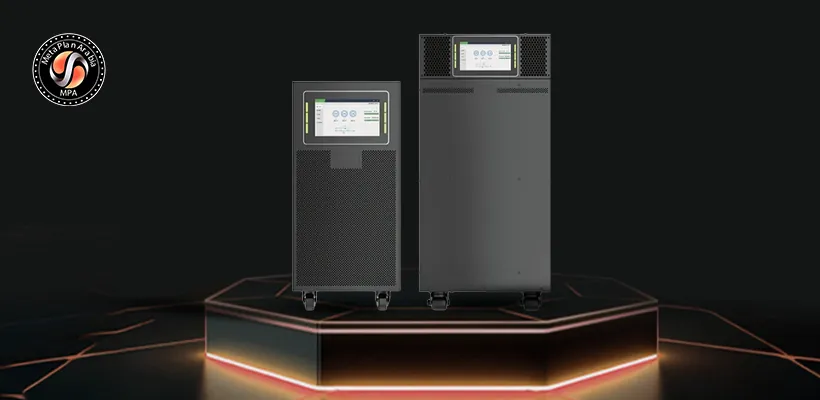
A 60-200 kVA Industrial UPS should be selected from measured critical load, usable kilowatts, runtime, redundancy, electrical distribution, and site conditions rather than nominal capacity alone, and MetaPlan supplies TM33E configurations for Saudi projects that require three-phase online protection across data centers, industrial control systems, telecom facilities, healthcare infrastructure, and large commercial operations.
industrial UPS protection for high-capacity critical loads
An industrial UPS in this range continuously converts incoming AC power to DC and recreates regulated AC output, keeping the protected load on the inverter during normal operation and utility disturbances.
The 60-200 kVA Industrial UPS range is designed for centralized three-phase loads where downtime can interrupt production, data processing, communications, building operations, or essential technical services.
Critical-load continuity requirements
MetaPlan supplies project-configured critical-power systems in Saudi Arabia, connecting UPS capacity, battery autonomy, upstream protection, generator coordination, monitoring, installation access, commissioning, and service requirements.
Share the measured load, site voltage, required backup time, generator details, and redundancy objective with MetaPlan to establish an engineered capacity carefully before equipment procurement begins.
60-200 kVA Industrial UPS capacity comparison
The 60-200 kVA Industrial UPS capacities should be compared by both apparent power and usable real power, because an identical kVA label can represent different available kilowatts across product families.
Verified TM33E UPS models use output power factor 1.0, so each selected kVA rating corresponds to the same nominal kilowatt rating under its approved operating configuration.
| Capacity | Nominal output at PF 1.0 | Typical decision context | Verified cabinet size |
|---|---|---|---|
| 60 kVA | 60 kW | Centralized industrial controls, telecom, medium data rooms | 250 × 868 × 828 mm |
| 80 kVA | 80 kW | Growing production, enterprise IT, technical facilities | 442 × 1200 × 850 mm |
| 100 kVA | 100 kW | Large IT zones, process systems, critical buildings | 442 × 1200 × 850 mm |
| 160 kVA | 160 kW | Large industrial or data-center power blocks | 442 × 1200 × 850 mm |
| 200 kVA | 200 kW | Major facilities, high-density loads, resilient architectures | 442 × 1200 × 850 mm |
A 60-200 kVA Industrial UPS should retain justified capacity for measured peaks, load growth, environmental derating, battery recharge, and redundancy instead of operating continuously at its published limit.
60 kVA UPS for centralized medium-load systems
A 60 kVA UPS provides up to 60 kW on the verified PF 1.0 TM33E platform, provided the connected equipment, phase balance, inrush, harmonics, and operating environment remain within design limits.
80 kVA UPS for expanding facilities
An 80 kVA UPS creates a larger centralized power block for expanding data, telecom, industrial, and commercial loads when measured demand and a documented growth margin support that choice.
100 kVA UPS for larger power blocks
A 100 kVA UPS supplies a larger critical-power block when the verified load, phase distribution, inrush, harmonic profile, growth allowance, autonomy, and installation conditions justify that capacity.
160 kVA UPS for major critical infrastructure
A 160 kVA UPS fits major continuous demand, but suitability still depends on selectivity, cable sizing, fault current, cooling, floor loading, bypass, batteries, and maintenance access.
200 kVA UPS for the highest range capacity
A 200 kVA UPS provides the highest single-unit capacity in this MetaPlan range, subject to complete verification of the distribution, redundancy, runtime, access, environmental, and commissioning requirements.
three phase UPS electrical architecture and site compatibility
A three phase UPS must match the facility distribution, and the TM33E high-capacity platform accepts three-phase input and supplies protected three-phase output at 380, 400, or 415 Vac.
The 60-200 kVA Industrial UPS uses 3-Level IGBT inverter technology, DSP control, input power factor of at least 0.99, and input current distortion no higher than three percent under stated conditions.
Generator, switchgear, and distribution coordination
Its broad input and frequency windows can support generator-backed or unstable utility environments, although the generator, protection, neutral, earthing, cable routing, and bypass paths still require project engineering.
A 60-200 kVA Industrial UPS is therefore not a substitute for a complete electrical design, because the surrounding switchgear and distribution determine whether the protected path remains safe and maintainable.
The broader uninterruptible power supply Saudi Arabia overview explains how continuity, voltage regulation, equipment protection, and local operating conditions jointly shape the complete backup strategy.
high capacity UPS battery runtime and charging design
A high capacity UPS requires an external battery system sized separately from the power converter, because kVA identifies supported load while stored energy determines autonomy during an outage.
The 60-200 kVA Industrial UPS supports project-configured VRLA strings or approved LFP battery cabinets, with programmable battery-bus voltage and model-dependent charger current that must match the selected storage architecture.
Runtime calculation inputs and battery scope
Accurate runtime planning starts with real load in kilowatts, target minutes, battery chemistry, string voltage, discharge rate, aging allowance, room temperature, recharge objective, and generator-start sequence.
Each high-capacity system may need only short bridging autonomy where a tested generator starts quickly, while controlled shutdown or extended continuity requires substantially more stored energy and space.
Ask MetaPlan for a load-based runtime calculation covering battery quantity, cabinets, DC protection, cabling, charging recovery, ventilation, access, and replacement planning as one coordinated design.
TM33E UPS redundancy, bypass, and monitoring options
The TM33E UPS can support direct parallel operation for capacity expansion or N+X redundancy across compatible units, subject to approved accessories, firmware, protection, cabling, configuration, and commissioning.
The 60-200 kVA Industrial UPS supports as many as eight compatible units and offers Load Bus Synchronization for coordinated dual-bus designs where the complete project architecture requires synchronized outputs.
Maintenance bypass and remote supervision
Maintenance bypass planning allows technicians to isolate the UPS while an approved alternate path supplies the load, but operating procedures and interlocks must prevent unsafe or unintended switching.
A 60-200 kVA Industrial UPS also benefits from event history, touchscreen status, dry contacts, RS-485, Modbus, and optional SNMP functions that integrate alarms and operating data with management systems.
online double conversion UPS efficiency and cooling
An online double conversion UPS protects sensitive loads through continuous power conversion, but conversion losses become heat that the electrical room cooling design must remove throughout normal operation.
ATENCO publishes online efficiency up to 95.5 percent and ECO efficiency up to 99 percent by model and configuration, while actual results depend on load level and operating mode.
Cooling and Saudi site conditions
Preliminary heat planning must therefore consider the chosen rating, expected loading, redundancy state, battery charging, ambient temperature, room ventilation, and manufacturer data for the final configuration.
A 60-200 kVA Industrial UPS installed in Saudi conditions should be protected from excessive heat, dust, obstructed airflow, poor access, and unsuitable floor loading through a documented site survey.
How to specify a 60-200 kVA Industrial UPS project
A complete specification converts operational requirements into measurable inputs, allowing suppliers and engineers to compare compliant systems without hiding important differences behind the same nominal power rating.
- Record critical load in kW and kVA, phase configuration, power factor, harmonics, inrush, growth, and any loads that can be shed.
- Define required runtime, battery chemistry, generator-start time, recharge window, redundancy level, bypass arrangement, and maintenance expectations.
- Confirm voltage, frequency, switchgear, fault level, earthing, cable routes, room cooling, floor loading, access, monitoring, and commissioning responsibilities.
This checklist separates converter capacity from autonomy and infrastructure, reducing the risk of buying sufficient nominal power with inadequate runtime, unsuitable distribution, or limited service access.
The existing 10-40 kVA Three-Phase UPS range remains the better intent owner for smaller loads, preventing unnecessary oversizing when measured demand stays below this high-capacity class.
MetaPlan TM33E project sizing and quotation
MetaPlan’s three phase UPS range lists 60, 80, 100, 160, and 200 kVA TM33E models with PF 1.0 output, 400V/50Hz configuration, dual input, and seven-inch monitoring.
For each 60-200 kVA Industrial UPS project, MetaPlan can review the load schedule, runtime target, redundancy, generator, battery system, installation constraints, monitoring interfaces, and required documentation before quotation.
Coordinated technical and commercial scope
Request an engineering project review with measured load and site information to receive a matched 60-200 kVA Industrial UPS configuration, coordinated accessories, and a clearer quotation scope.
Frequently asked questions
These answers address common buyer questions about three-phase architecture, capacity selection, differences between TM33E platforms, and parallel operation for large critical-power projects today.
A three-phase UPS accepts three-phase electrical input, supplies protected three-phase output, and is commonly used for larger data-center, industrial, telecom, infrastructure, and commercial critical loads.
The correct size exceeds the measured critical load in both kW and kVA while accounting for power factor, peaks, harmonics, growth, derating, runtime, redundancy, and manufacturer limits.
The smaller platform serves lower three-phase loads, while the high-capacity platform adds larger cabinets, stronger charging, parallel operation up to eight units, and Load Bus Synchronization capabilities.
Compatible TM33E units can be engineered in parallel for capacity or N+X redundancy, provided approved kits, switchgear, protection, batteries, cabling, firmware, configuration, and commissioning are specified.