



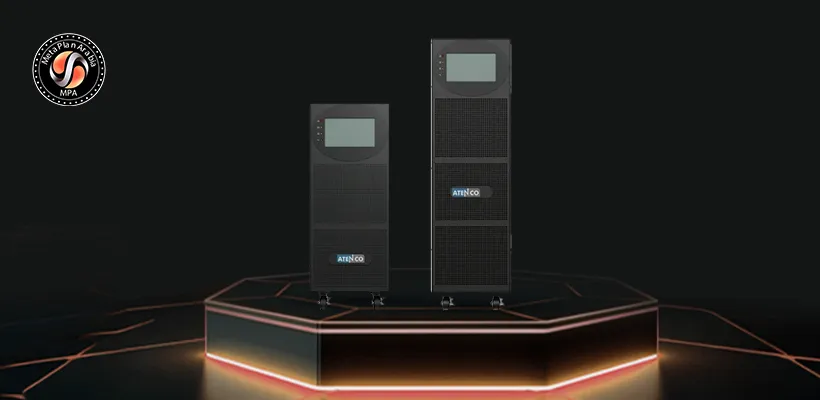
Power outages can stop servers, disconnect users, and disrupt critical systems within seconds. A reliable 6KVA UPS protects sensitive equipment from outages and unstable power. MetaPlan helps businesses across Saudi Arabia select the right online rack or tower solution based on load, runtime, and installation requirements. This guide explains everything you should check before choosing your system.
What Is a 6KVA UPS?
A 6KVA UPS is an uninterruptible power supply rated at 6,000 volt-amperes. It provides temporary backup power while protecting connected equipment from outages, voltage fluctuations, and other electrical disturbances.
The 6kVA rating represents apparent power, not necessarily the usable output in watts. The actual wattage depends on the power factor and technical design of the selected model.
For example, two systems with the same 6kVA rating may support different loads if their power factors are different. This is why MetaPlan calculates the connected load in watts before recommending a 6KVA UPS.
A professional load assessment should include:
- The normal operating load
- Startup and peak-power requirements
- Additional capacity for future expansion
- The required safety margin
- The desired battery runtime
- Any redundancy requirements
Selecting a UPS based only on its kVA rating may result in insufficient capacity, unnecessary cost, or inadequate backup time.
When Does a Business Need a 6KVA UPS?
A 6KVA UPS becomes relevant when smaller backup systems cannot safely support the combined equipment load or when a business needs centralized protection for several devices.
Common applications include:
- Servers and network switches
- Small server and communication rooms
- CCTV and access-control systems
- Business workstations
- Point-of-sale systems
- Telecommunications equipment
- Medical and laboratory devices
- Industrial control equipment
- Security and monitoring systems
The suitability of the system depends on the total load rather than the number of connected devices. A small number of high-consumption devices may require more capacity than many low-power devices.
MetaPlan evaluates the actual wattage, operating environment, and required runtime to determine whether a 6kVA system is the right choice.
Why Choose an Online Double Conversion UPS?
An online double conversion UPS continuously processes incoming electricity before supplying it to connected equipment.
Incoming AC power is converted to DC and then converted back to regulated AC power through the inverter. Because protected equipment receives power through the inverter during normal operation, the UPS does not need to switch from the main supply to the battery when an outage occurs.
This technology provides several advantages:
- No transfer delay when the main supply fails
- Stable output for sensitive equipment
- Protection from voltage fluctuations
- Isolation from many incoming electrical disturbances
- Reliable operation for business-critical loads
- Better power conditioning than basic standby systems
An online 6KVA UPS is commonly selected for servers, network infrastructure, medical equipment, telecommunications, and other applications where even a brief interruption could affect operations.
Online UPS vs Line-Interactive UPS
A line-interactive UPS can regulate moderate voltage changes without immediately using its batteries. It may be suitable for workstations and less critical equipment.
An online UPS provides a higher level of protection because the connected load is continuously supplied through the inverter.
The correct choice depends on the importance and sensitivity of the equipment:
- Choose line-interactive technology for ordinary equipment with moderate protection requirements.
- Choose online double conversion technology for critical systems that require continuous and stable power.
For server rooms and essential business infrastructure, protection quality is usually more important than selecting the lowest initial price.
6 KVA Online UPS Tower Supplier KSA
Businesses searching for a 6 KVA online UPS tower supplier KSA usually need a standalone system that can be installed beside servers, electrical equipment, production systems, or technical workstations.
A tower 6KVA UPS does not require a dedicated equipment rack. It can therefore be a practical solution for offices, facilities, workshops, and technical rooms with sufficient floor space.
Before selecting a tower system, MetaPlan checks:
- The physical dimensions of the unit
- Available installation space
- Required ventilation clearance
- Input and output voltage
- Maximum supported wattage
- Internal or external battery requirements
- Communication and monitoring options
- Access for maintenance
The selected 6KVA UPS should provide sufficient capacity without blocking airflow or making battery replacement and maintenance difficult.
Advantages of a Tower UPS
A tower configuration can offer:
- Straightforward standalone installation
- Easy access for inspection
- Flexible placement inside technical rooms
- No requirement for rack space
- Support for different battery configurations
However, the installation area must remain clean, ventilated, and protected from excessive heat, moisture, and dust.
6 KVA Rack UPS Supplier Riyadh
A company searching for a 6 KVA rack UPS supplier Riyadh normally needs a system that can be installed inside an existing server or network rack.
Rack-mounted units are suitable for data cabinets, server rooms, surveillance infrastructure, and communication environments where equipment must remain centrally organized.
Before MetaPlan recommends a rack 6KVA UPS, the following points are reviewed:
- Rack width and compatibility
- Available rack units
- UPS depth
- Maximum rack weight
- Front and rear ventilation
- External battery placement
- Cable-routing requirements
- Maintenance access
The 6KVA UPS and its battery modules may be heavy. Rack stability, rail compatibility, and weight distribution must therefore be considered during installation.
Advantages of a Rack UPS
A rack-mounted system offers:
- Efficient use of technical-room space
- Organized installation with servers and switches
- Centralized cable management
- Easier integration with existing IT infrastructure
- A professional server-room setup
Some systems support convertible Rack/Tower installation. This allows the unit to be installed horizontally inside a rack or vertically as a tower when the installation environment changes.
Rack UPS vs Tower UPS: Which Should You Choose?
The electrical protection may be similar, but the physical installation requirements are different.
Choose a tower UPS when:
- A server rack is not available
- Sufficient floor space exists
- The UPS will stand beside the protected equipment
- Easy standalone access is required
Choose a rack UPS when:
- Servers and switches are already rack-mounted
- Floor space is limited
- Equipment must be centrally organized
- The UPS will be installed inside a server cabinet
Choose a convertible Rack/Tower model when:
- The installation may change in the future
- Additional placement flexibility is required
- The same system may be moved between locations
MetaPlan considers space, ventilation, rack capacity, battery placement, and maintenance access before recommending the most suitable configuration.
How to Calculate the Required UPS Capacity
Before ordering a 6KVA UPS, create a complete list of the equipment that will be connected to it. Record the maximum wattage of each device and calculate the combined load.
The selected system should not operate continuously at its absolute maximum capacity. A suitable operating margin helps accommodate temporary load increases and future equipment expansion.
The capacity assessment should include:
- The maximum wattage of every connected device
- Startup or peak-power requirements
- The UPS output power factor
- Additional capacity for future equipment
- The recommended operating margin
- The required battery runtime
A site assessment is especially important when the system will support motors, medical devices, industrial equipment, or other loads with significant startup requirements.
MetaPlan can evaluate the connected equipment and calculate the capacity required for safe and reliable operation.
How Long Can a 6KVA UPS Run?
The capacity rating alone does not determine runtime. A 6KVA UPS can provide very different backup durations depending on the connected load and battery configuration.
Runtime is affected by:
- The actual load in watts
- Battery capacity
- Number of battery modules
- Battery age and condition
- UPS efficiency
- Room temperature
- Frequency of battery use
Businesses should define what the UPS must accomplish during an outage.
The objective may be to:
- Bridge short power interruptions
- Keep systems operating until a generator starts
- Provide time for a controlled shutdown
- Maintain critical equipment for an extended period
A lightly loaded UPS will usually provide more runtime than the same unit operating close to its maximum supported load.
Long-runtime applications may require external battery modules or a dedicated battery bank. MetaPlan calculates the expected runtime using the actual load and selected battery configuration.
Internal Batteries vs External Battery Systems
UPS systems with internal batteries offer a compact configuration and are often sufficient for short backup periods.
External battery systems are used when longer runtime is required. They provide more flexibility but require additional installation space, suitable electrical protection, correct cabling, and proper ventilation.
Battery selection should consider:
- Required runtime at the actual load
- Battery voltage and capacity
- UPS charger capability
- Available installation space
- Operating temperature
- Battery replacement and maintenance
- Compatibility with the selected UPS
Connecting an unsuitable battery system may affect performance, charging, safety, and warranty coverage. MetaPlan therefore matches the battery configuration to the technical requirements of the UPS.
Why Temperature Matters in Saudi Arabia
High temperatures can reduce battery performance and shorten service life. This makes installation conditions particularly important for UPS systems operating in Saudi Arabia.
The 6KVA UPS and batteries should be installed in an appropriate indoor environment with:
- Effective ventilation
- Controlled temperature
- Protection from direct sunlight
- Sufficient clearance around ventilation openings
- Protection from moisture and excessive dust
- Regular inspection and preventive maintenance
A UPS should not be installed inside a closed cabinet or unventilated room unless the environment has been designed to manage heat safely.
Monitoring and Management Features
A UPS should provide more than battery backup. Monitoring features help technical teams identify abnormal conditions before they cause an unexpected shutdown.
Useful capabilities may include:
- LCD status display
- Load and battery indicators
- Audible alarms
- USB or serial communication
- SNMP network monitoring
- Remote notifications
- Automatic shutdown software
- Event and fault records
Remote monitoring is especially useful when the 6KVA UPS protects an unattended server room or equipment distributed across multiple locations.
MetaPlan can help determine whether local monitoring is sufficient or whether the application requires remote network management.
What Affects the 6KVA UPS Price in Saudi Arabia?
The 6KVA UPS price in Saudi Arabia varies because products with the same capacity can have different technologies, output ratings, battery configurations, and support services.
The final price may depend on:
- Online or line-interactive technology
- Rack, tower, or convertible design
- Output power factor
- Usable wattage
- Internal or external batteries
- Required runtime
- Monitoring and network-management cards
- Installation and commissioning
- Warranty coverage
- Maintenance and technical support
A low equipment price does not necessarily provide the lowest total cost. Batteries, installation, maintenance, downtime risk, and future replacement should be considered when comparing quotations.
MetaPlan prepares solutions according to the actual application rather than recommending unnecessary capacity or an unsuitable battery configuration.
How to Select a Reliable UPS Supplier in Riyadh
A reliable supplier should assess the application before recommending a product. Supplying a 6KVA UPS without understanding the load and runtime requirements can result in poor performance or unnecessary cost.
Before accepting a quotation, ask the supplier to confirm:
- The supported load in watts
- The recommended operating margin
- Expected runtime at the calculated load
- Battery type and configuration
- Rack or tower installation requirements
- Input and output electrical requirements
- Monitoring options
- Warranty coverage
- Installation and commissioning services
- Preventive maintenance and replacement support
The quotation should clearly identify everything included in the solution. Check whether batteries, rails, cables, network cards, installation, testing, and delivery are included or priced separately.
As a UPS supplier in Riyadh, MetaPlan helps customers evaluate the complete solution instead of comparing products based only on their capacity and purchase price.
UPS supplier in Saudi Arabia selection criteria
A qualified UPS supplier in Saudi Arabia should document usable wattage, battery runtime assumptions, installation format, and environmental limits before preparing a quotation.
Comparing UPS system suppliers Saudi Arabia businesses consider also requires checking commissioning capability, maintenance access, replacement battery availability, and the clarity of technical documentation.
UPS solution suppliers in Riyadh and site assessment
UPS solution suppliers in Riyadh should examine the connected load, electrical distribution, rack or floor space, ventilation, and required operating margin at the installation site.
For a UPS 6 KVA system, this assessment should separate apparent power from usable watts and calculate runtime against the actual protected equipment.
UPS solution suppliers in KSA and regional support
Evaluating UPS solution suppliers in KSA includes confirming whether technical support can reach the project location and whether spare parts suit the installed model.
The same checks apply to UPS solution suppliers in Saudi Arabia and UPS solution suppliers in Dammam. A dependable UPS supplier KSA team should define response scope and maintenance responsibilities in writing.
Installation and Commissioning
Correct installation is essential for the reliable operation of a 6KVA UPS.
Before installation, the technical team should verify:
- The electrical supply and circuit capacity
- Input and output cable sizes
- Earthing requirements
- Protection and isolation devices
- Equipment placement
- Ventilation and temperature
- Battery connections
- Load distribution
After installation, commissioning should confirm that the system operates correctly under normal conditions and during a simulated power failure.
Testing may include:
- Verifying input and output readings
- Confirming battery charging
- Testing alarms and indicators
- Checking the connected load
- Confirming network communication
- Testing transfer to battery operation
- Recording the initial system condition
MetaPlan can support system selection, installation planning, commissioning, and ongoing technical requirements.
Preventive Maintenance and Battery Replacement
UPS systems require regular inspection even if power outages are uncommon. Batteries can deteriorate over time without obvious external signs.
A preventive maintenance visit may include:
- Visual inspection
- Battery-voltage checks
- Connection inspection
- Alarm and event review
- Ventilation inspection
- Load measurement
- Functional testing
- Cleaning where appropriate
Battery replacement should be planned before the batteries become unreliable. The replacement schedule depends on battery technology, temperature, usage, and manufacturer recommendations.
Maintaining accurate service records helps businesses monitor performance and prepare for future replacement costs.
Choose the Right 6KVA UPS with MetaPlan
Choosing the best 6KVA UPS begins with understanding the protected load, required runtime, and installation environment—not selecting a model from a catalogue without an assessment.
MetaPlan provides UPS and backup-power solutions for organizations in Riyadh and across Saudi Arabia. Our team can evaluate your equipment load, required battery runtime, installation format, operating conditions, and monitoring requirements.
Whether you need an online tower UPS, a rack-mounted system, or an extended-runtime battery solution, MetaPlan can help you select a suitable configuration for your business.
Contact MetaPlan to request a technical consultation and receive a solution based on your actual operational requirements.
Frequently Asked Questions
A 6KVA UPS can support a small server room when the total equipment load remains within its usable wattage. The calculation should also include peak demand, required runtime, a suitable operating margin, and future expansion.
A rack UPS is installed inside a server or network cabinet, while a tower UPS operates as a standalone floor unit. The best option depends on the available space, existing infrastructure, ventilation, battery placement, and maintenance access.
Calculate the equipment load in watts, define the required battery runtime, and determine whether you need a rack or tower installation. MetaPlan can assess these requirements and recommend a suitable UPS and battery configuration for your business.